
Jump To Section
- 1 Why Legacy Telecom Architecture is Becoming a Constraint
- 2 Hybrid Cloud as the New Telecom Operating Model
- 3 Edge Workloads and the Emergence of Distributed Network Computing
- 4 Three telecom use cases driving hybrid cloud and edge adoption
- 5 Operating Distributed Hybrid Infrastructure
- 6 Industry Analysis: Rising Investment in Hybrid Cloud and Edge Infrastructure
- 7 Final Takeaway: The Next Phase of Telecom Edge and Hybrid Cloud
- 8 FAQs
Telecom operators are under pressure to support low-latency services, AI workloads, and enterprise applications without adding more complexity to already fragmented networks.
Legacy telecom environments were built around centralized systems and tightly coupled platforms designed for reliability. That model still matters for core operations, but it slows service delivery when operators need to support distributed applications, real-time analytics, and AI-driven automation.
Modern telecom services increasingly depend on distributed computing architectures where workloads operate across public cloud environments, operator data centers, and edge locations close to end users.
Hybrid cloud and edge computing are therefore becoming central to telecom modernization because they let operators run workloads across public cloud environments, private infrastructure, and edge locations near users and devices. That architecture supports faster decisions, lower latency, and better alignment between workload requirements and infrastructure design.
Research suggests that telecom companies that modernize infrastructure around hybrid cloud and edge computing can reduce operational costs by up to 30–40% while enabling faster service innovation.
This article explores how hybrid cloud and edge architectures are reshaping telecom networks. In it, you’ll find key use cases driving this transformation, and learn how operators are evolving their infrastructure to support next-generation digital services.
Why Legacy Telecom Architecture is Becoming a Constraint
Telecommunications infrastructure is undergoing one of the most significant architectural transformations since the emergence of mobile broadband.
Historically, telecom networks were designed around centralized systems and tightly coupled platforms that prioritized reliability and scale.
But the rapid growth of 5G, artificial intelligence (AI), Internet of Things (IoT), and enterprise digital services is forcing operators to rethink this model.
Over 70% of telecom operators today cite OSS/BSS complexity as a primary barrier to digital transformation. Legacy operational and business support systems often consist of tightly coupled platforms, fragmented data environments, and manual processes that limit innovation and increase operational overhead.
Research across the telecom industry shows that monolithic OSS/BSS systems create significant challenges in agility, service orchestration, and integration with modern digital platforms. As a result, operators increasingly seek architectural approaches that enable modular services, distributed data processing, and cloud-native operations.
The limitations of legacy architectures have accelerated the shift toward hybrid cloud and edge computing models, which enable telecom networks to distribute workloads intelligently across multiple environments while maintaining operational resilience.
Hybrid Cloud as the New Telecom Operating Model
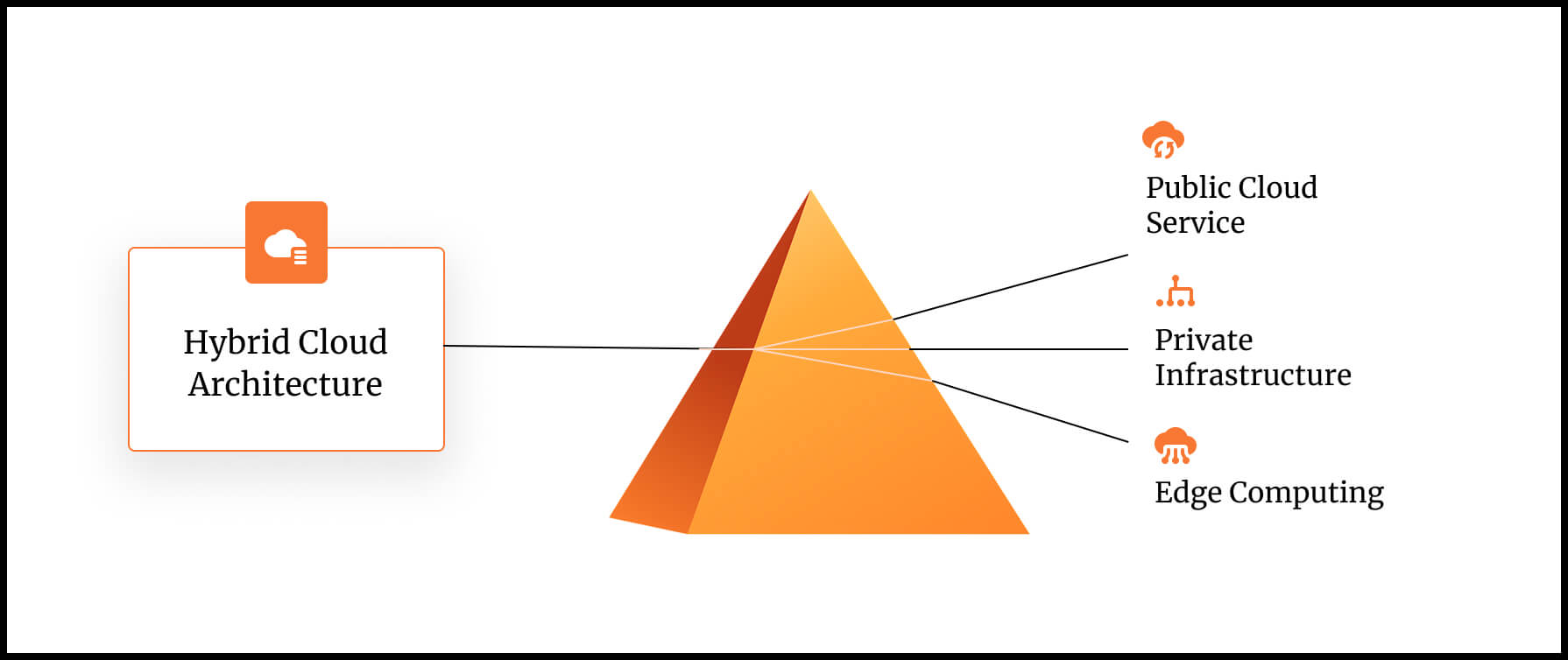
Hybrid cloud architecture enables telecom operators to combine multiple computing environments into a unified operational platform. Instead of relying solely on operator data centers or moving entirely to public cloud infrastructure, hybrid architectures distribute workloads across different environments based on performance, regulatory, and operational requirements.
In telecom networks, hybrid cloud typically includes three primary layers:
- Public cloud platforms, which provide scalable computing resources for analytics, artificial intelligence, and large-scale application workloads.
- Private cloud environments, which allow telecom operators to maintain control over sensitive data, regulatory workloads, and core network functions.
- Edge infrastructure, which places computing resources within telecom network sites to support real-time services close to users and devices.
| Infrastructure Layer | Role |
| Private Data Centers | Core network functions, regulatory workloads |
| Public Cloud | Data platforms, AI, digital services |
| Edge Infrastructure | Low-latency applications and distributed services |
Research indicates that many telecom operators are adopting hybrid architectures because different workloads require different levels of latency, data governance, and scalability.
For example, AI model training and large-scale analytics can run efficiently in centralized cloud environments, while real-time decision-making and network optimization often require computing resources closer to network users.
Real-time use cases
- Industrial automation: Factories connect production equipment to private 5G networks. Edge computing processes sensor data locally, enabling real-time control of machinery and robotics.
- Predictive maintenance: Machine data from industrial sensors analyzed locally to detect anomalies and prevent equipment failure.
Hybrid cloud architecture therefore acts as the control plane for distributed telecom infrastructure, enabling operators to orchestrate workloads across cloud environments, private infrastructure, and edge nodes.
Edge Workloads and the Emergence of Distributed Network Computing
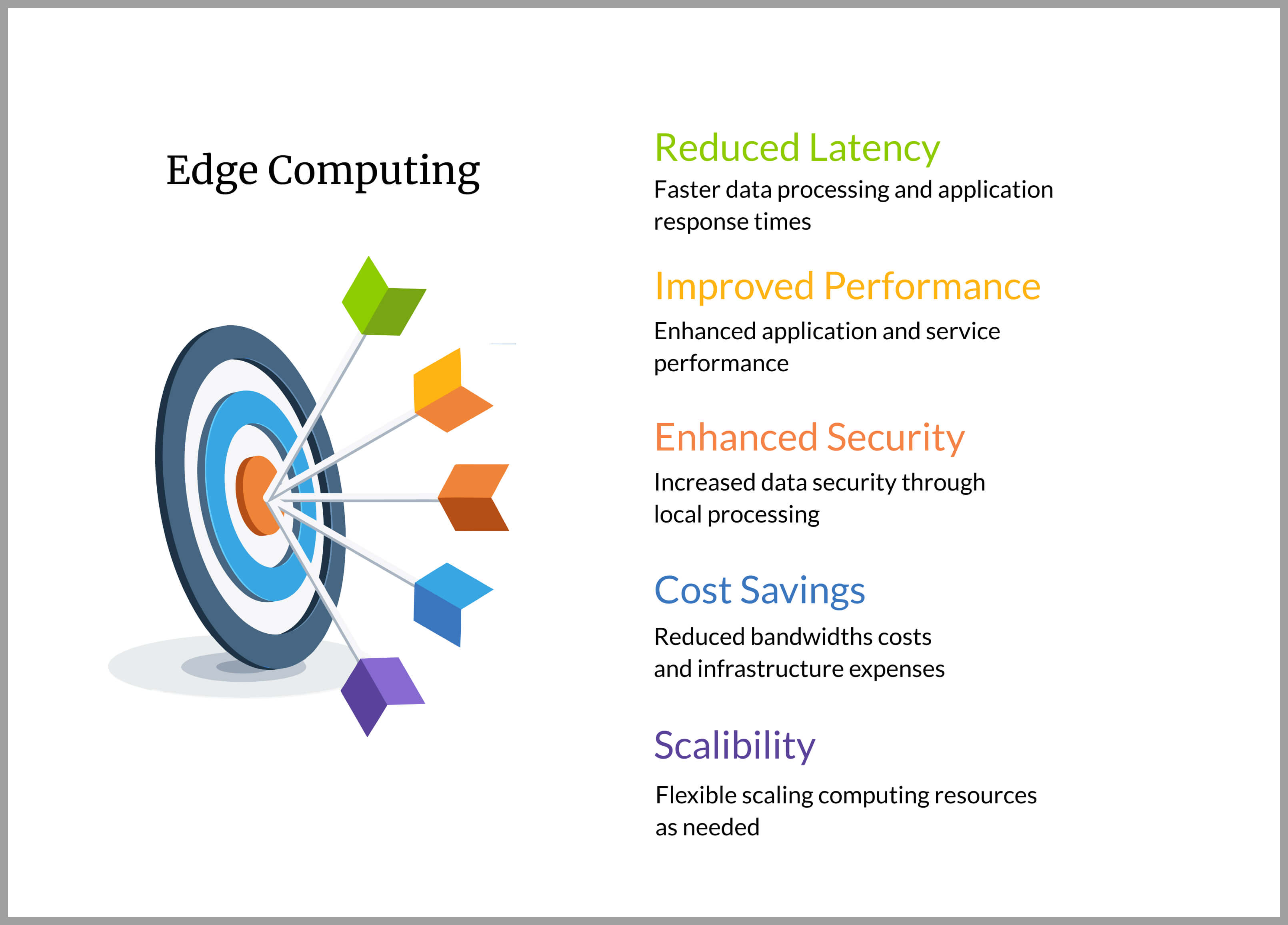
Edge computing refers to the deployment of computing resources within telecom infrastructure locations that are physically closer to end users and devices.
Instead of sending data to centralized data centers for processing, edge computing allows applications and services to run directly within telecom network sites.
In telecom environments, edge computing infrastructure may be deployed at locations such as:
- radio access network (RAN) sites
- central offices
- regional aggregation sites
- metro data centers
These sites already contain critical infrastructure such as power, cooling, and network connectivity. By upgrading these facilities with cloud-native computing platforms, telecom operators can transform them into distributed edge computing nodes capable of hosting applications and AI workloads.
Recent industry initiatives highlight how telecom operators are integrating AI workloads directly within network infrastructure.
For example, AI-enabled RAN architectures combine network optimization algorithms with edge computing platforms, allowing the same infrastructure to support both network intelligence and enterprise services.
This architectural shift effectively turns telecom networks into distributed computing environments where processing can occur across thousands of geographically distributed locations.
Three telecom use cases driving hybrid cloud and edge adoption
Hybrid cloud and edge computing enable telecom operators to support a range of emerging services that require real-time processing and distributed infrastructure.
1) Edge computing enables AI-Driven Network Optimization
Artificial intelligence is increasingly used to optimize telecom network performance. AI models analyze network telemetry, traffic flows, and device activity to predict congestion and adjust network parameters dynamically.
Running AI inference workloads at the edge allows telecom operators to respond to network conditions in real time. By processing data closer to the radio network, operators can improve spectrum utilization, reduce service disruptions, and automate network management.
Research highlights that AI-enabled RAN platforms can significantly improve operational efficiency while supporting autonomous network operations across distributed infrastructure
2) Multi-Access Edge Computing for Enterprise Services
Telecom operators are increasingly deploying Multi-Access Edge Computing (MEC) platforms within network sites to provide computing resources for enterprise customers.
By hosting enterprise applications at telecom edge locations, operators can deliver ultra-low latency services for industries such as manufacturing, logistics, healthcare, and transportation.
Examples include:
- Real-time industrial automation for smart factories
- Augmented reality support for remote maintenance
- Edge analytics for logistics and supply chain tracking
- Low-latency applications for connected vehicles
Because these applications operate directly within the telecom network, operators can combine connectivity, compute, and quality-of-service guarantees, creating differentiated services that public cloud providers alone cannot deliver.
3) Real-Time Data Processing and Analytics
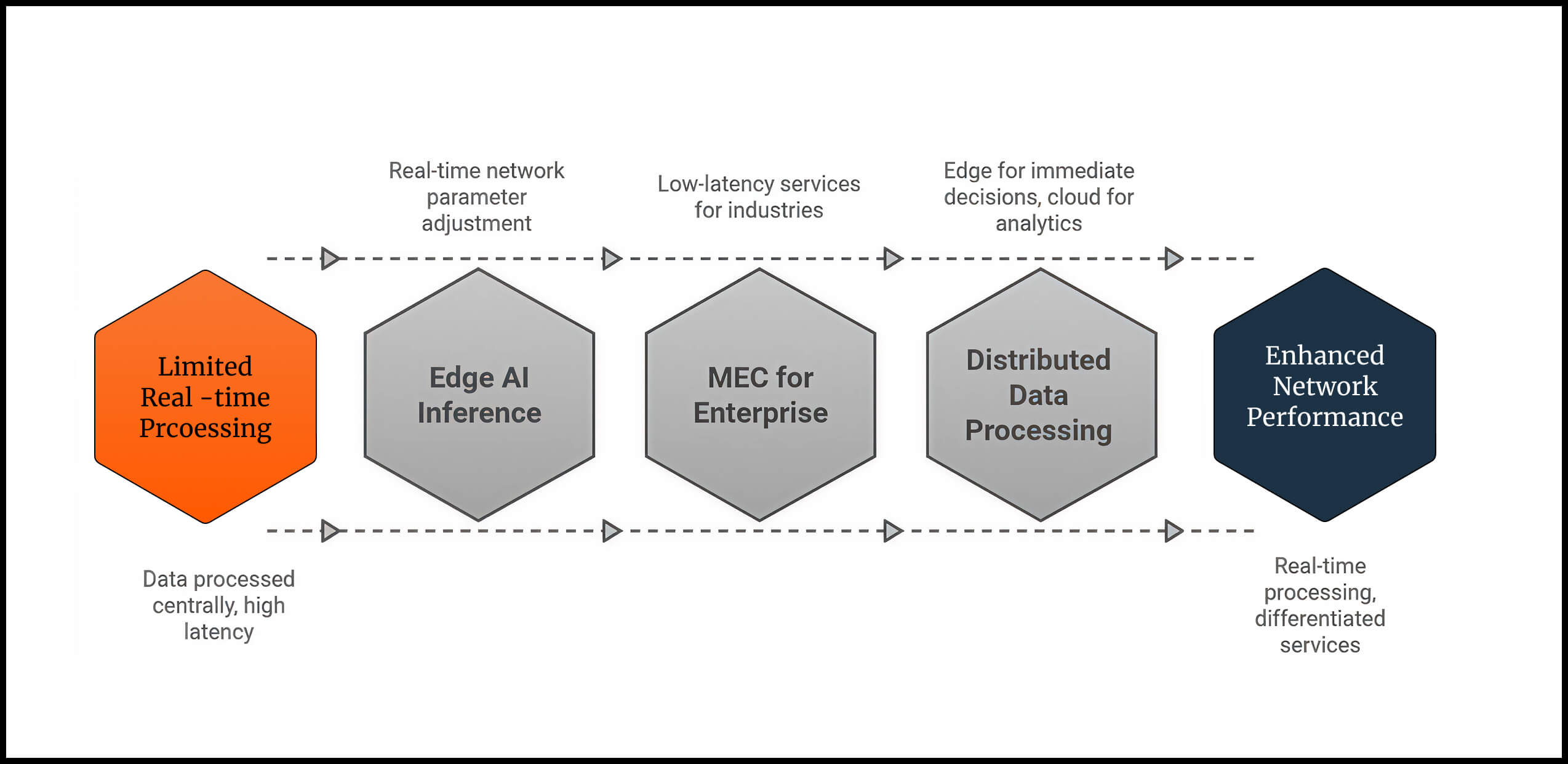
5G networks generate enormous volumes of operational and user-level data. Hybrid cloud and edge architectures allow telecom operators to process this data across distributed environments.
Edge infrastructure can analyze real-time network data for immediate operational decisions, while centralized cloud environments perform large-scale analytics and machine learning.
The rise of AI and automation is driving telecom operators to capture and analyze significantly more operational data than before, including data that was previously discarded. Hybrid architectures allow operators to process this data efficiently while maintaining governance and compliance across environments.
Operating Distributed Hybrid Infrastructure
Managing distributed infrastructure across cloud platforms, private networks, and edge locations introduces new operational challenges for telecom operators.
Hybrid environments require advanced orchestration platforms capable of managing workloads across multiple environments while maintaining performance, security, and compliance.
Modern telecom networks increasingly rely on automation and AI-driven orchestration systems that monitor infrastructure continuously and dynamically allocate resources based on demand.
These systems use real-time telemetry to observe network conditions, plan adjustments, and implement changes automatically. This approach enables telecom operators to operate large-scale distributed infrastructure efficiently while reducing manual operational overhead.
Industry Analysis: Rising Investment in Hybrid Cloud and Edge Infrastructure
Recent industry analysis shows that telecom operators are rapidly increasing investment in hybrid cloud and edge infrastructure as part of their 5G and AI transformation strategies.
- According to GSMA Intelligence (2025), more than 60% of global telecom operators are actively deploying edge computing infrastructure as part of their 5G network modernization programs.
- McKinsey (2025) estimates that edge computing could unlock $150–200 billion in telecom-related enterprise revenue opportunities by 2030, primarily through industrial automation, AI services, and real-time data platforms.
- TM Forum research also indicates that telecom operators are increasingly integrating AI-driven network optimization with distributed edge infrastructure, enabling more autonomous and efficient network operations (TM Forum, 2025).
These trends show that hybrid cloud and edge computing are no longer experimental technologies. They are becoming core architectural components of telecom networks.
For a detailed look into the 10 Telecom Trends Shaping AI-Assisted Modernization in 2026 and Beyond, read this guide here.
Final Takeaway: The Next Phase of Telecom Edge and Hybrid Cloud
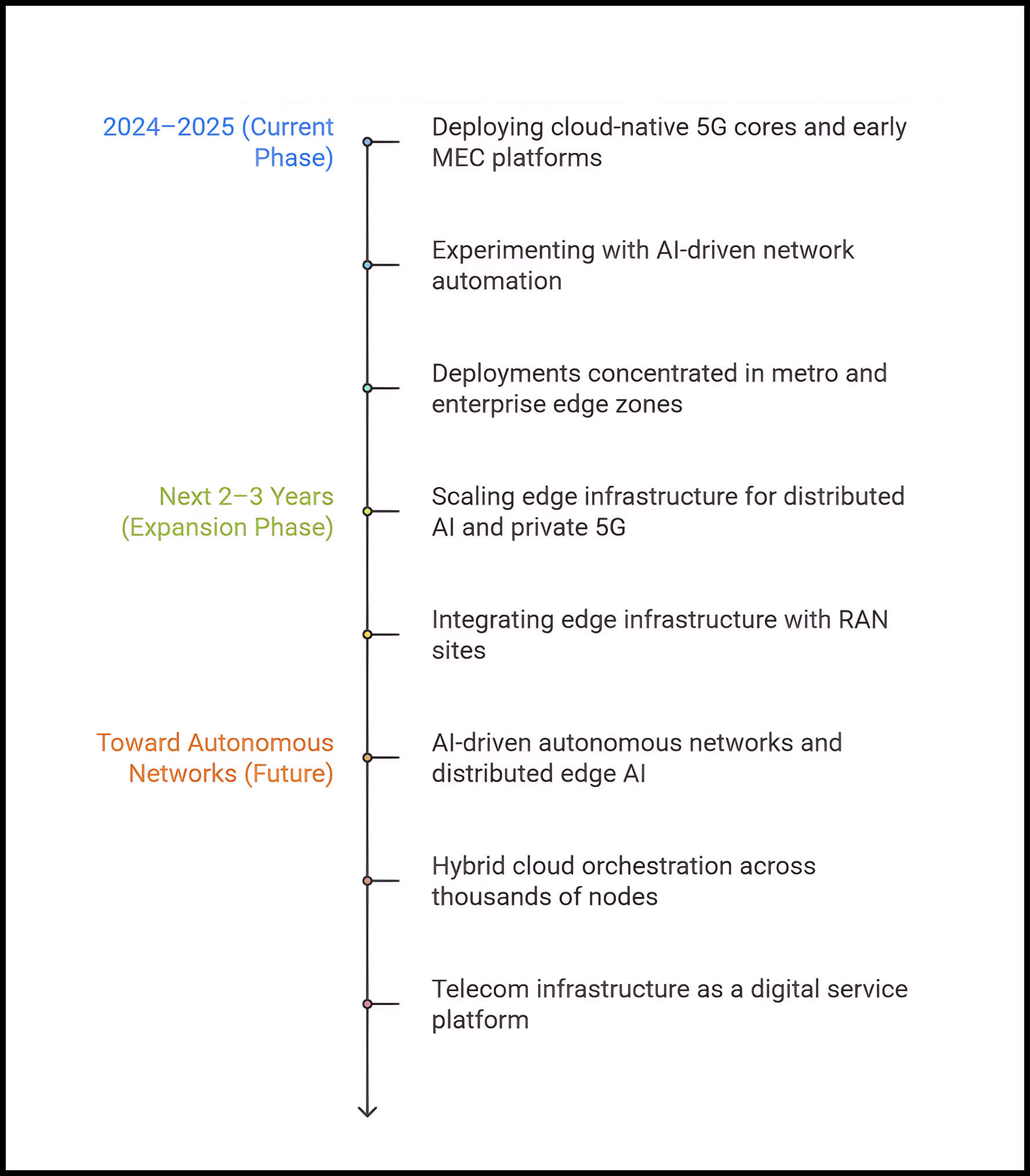
Hybrid cloud and edge computing adoption is accelerating across the telecom industry, with many operators already beginning to deploy distributed edge platforms and cloud-native network functions as part of their 5G transformation programs.
Telecom operators are rapidly increasing investment in hybrid cloud and edge infrastructure as part of their 5G and AI transformation strategies, particularly to support AI inference workloads that require real-time processing at the network edge. Over the next several years, the number of edge-enabled telecom sites is expected to grow significantly as operators modernize network infrastructure and expand distributed computing capabilities.
As AI-driven applications and enterprise digital services continue to evolve, telecom networks will increasingly function as distributed digital platforms rather than centralized connectivity systems.
Hybrid cloud architectures will provide the orchestration layer that connects cloud platforms, telecom infrastructure, and edge environments, enabling telecom operators to deliver new digital services at scale.
FAQs
What is hybrid cloud in telecom?
Hybrid cloud in telecom is an operating model that runs workloads across private infrastructure, public cloud, and edge environments based on latency, security, performance, and cost needs. It helps operators place each workload where it works best instead of forcing everything into one environment.
Why are telecom operators adopting edge computing?
Telecom operators are adopting edge computing to support low-latency applications, faster data processing, and real-time decision-making closer to users and devices. This is especially useful for AI inference, industrial automation, smart city services, and enterprise applications that cannot tolerate delay.
How does hybrid cloud improve telecom network performance?
Hybrid cloud improves telecom network performance by letting operators match workloads to the right environment. Time-sensitive workloads can run at the edge, while analytics and model training can run in centralized cloud environments. That reduces latency, improves responsiveness, and supports more efficient use of network resources.
What are the main challenges of hybrid cloud and edge in telecom?
The main challenges include managing distributed infrastructure, orchestrating workloads across multiple environments, maintaining visibility across network locations, and enforcing governance consistently. For most operators, the operating model is harder than the infrastructure build itself.
What telecom use cases benefit most from hybrid cloud and edge architecture?
The strongest use cases include AI-driven network optimization, multi-access edge computing for enterprise services, and real-time analytics. These use cases benefit because they require a mix of fast local processing, scalable cloud resources, and tighter coordination across network and application layers.