Jump To Section
- 1 Why AI Has Made the Enterprise Delivery Governance Problem Impossible to Ignore
- 2 What Is the Real Cost of Ungoverned Software Delivery?
- 3 The New Enterprise Question Every CTO Should Be Asking
- 4 What Is Spec-Driven Delivery, and How Is It Different From Traditional SDD?
- 5 Traditional Spec-Driven Development vs. ML Arteka Spec-Driven Delivery
- 6 Why Enterprise AI Governance Starts with the Specification, Not the Toolchain
- 7 How Does ML Arteka’s Spec-Driven Delivery Framework Work?
- 8 Three Moves from Ungoverned Delivery to Operationalized Delivery
- 9 The Delivery Governance Category No One Is Building Yet
- 10 Frequently Asked Questions About Spec-Driven Delivery
- 11 Start With a Baseline
Key takeaways
- Spec-Driven Delivery (SDD) treats the specification as a governed operational asset instead of a throwaway development document.
- AI didn’t fix the enterprise delivery problem, but moved the bottleneck from code generation to governance, traceability, and auditability.
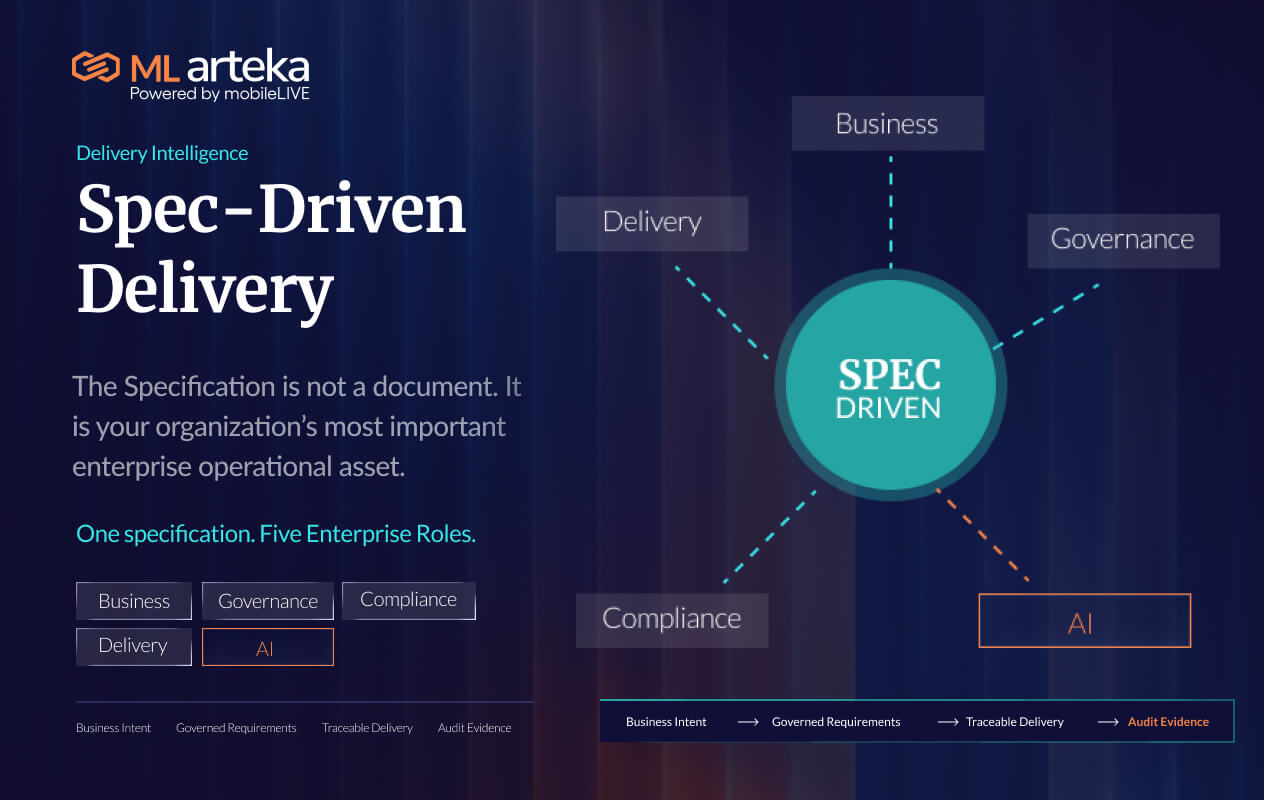
- One governed specification serves five roles at once: business, governance, compliance, delivery, and AI instruction set.
- In BFSI, ungoverned AI velocity now collides with DORA, the EU AI Act, and model-risk regimes, making traceability a board-level exposure.
- SDD builds compliance and audit evidence into the pipeline from sprint one, so organizations arrive at audits with traceability already in place.
- Take five minutes to assess your delivery system across six dimensions and see where it’s most exposed: Delivery Readiness Assessment.
A financial services organization deployed AI-assisted development tools across their engineering teams last year.
Code output increased significantly, but six months later, audit preparation took three weeks longer than the year before and a compliance review surfaced traceability gaps that engineering had no documentation to close.
They had not failed to adopt AI. They had adopted AI on top of an ungoverned delivery foundation.
That is the pattern we’re seeing consistently across enterprise organizations right now:Velocity is increasing. Governance isn’t keeping pace. And the gap between them is compounding every quarter.
Most conversations about Spec-Driven Development focus on engineering productivity. That’s understandable: productivity is measurable, it’s what engineering teams optimize for, and it’s what AI vendors sell. But code generation was never the real enterprise bottleneck.
The bottleneck simply moved.
Most teams can’t say with confidence where that gap sits in their own delivery system. A five-minute Delivery Readiness Assessment scores it across six dimensions and shows you what needs attention.
Why AI Has Made the Enterprise Delivery Governance Problem Impossible to Ignore
AI removed the capacity constraint and exposed the governance one. When engineers couldn’t write code fast enough, slow delivery was easy to diagnose. Now that AI generates implementation in minutes, the failure point has shifted to requirements clarity, decision traceability, and audit evidence – the parts of delivery that AI tools don’t touch.
Before AI-assisted development, slow delivery was easy to diagnose. Engineers couldn’t write code fast enough. Capacity was the constraint.
That constraint is largely gone.
GitHub Copilot, Claude Code, Cursor, and a generation of AI coding tools have fundamentally changed how software gets written. Organizations deploying these tools are generating code faster than at any point in their history.
And yet delivery is still breaking down.
Timelines slip. Audit evidence gets assembled manually in the days before a review. Requirements get interpreted differently by engineering than by the business. Compliance teams are brought in late. Rework absorbs a significant portion of engineering capacity every quarter not because engineers are slow, but because the governance foundation beneath the code is inconsistent.
The organizations struggling most right now are not the ones that failed to adopt AI. They are the organizations that adopted AI on top of an ungoverned delivery structure. They accelerated the wrong thing.
‘AI amplifies what already exists. If your underlying delivery structure is strong, AI multiplies your output. If it’s weak, AI multiplies your risk.’
What Is the Real Cost of Ungoverned Software Delivery?
The cost shows up as rework, slipped timelines, and failed or delayed audits — not slow engineering. Across ML Arteka’s delivery readiness assessments with mid-to-large enterprises, four governance gaps consistently drive the most lost velocity, the lowest compliance confidence, and the least predictable delivery.
The gaps cluster in four dimensions (based on ML Arteka delivery readiness data, 2024–2026):
| Gap | What goes wrong | Downstream consequence |
| Requirements clarity | Business intent doesn’t survive translation into engineering work | Teams build what they interpreted, not what was intended |
| Delivery governance | Decisions made informally, inconsistently, without traceability | Months later, no one can reconstruct why choices were made |
| Compliance & traceability | Evidence assembled after the fact, not built into the pipeline | Audit prep becomes a project of its own |
| Team alignment | Engineering and business run on different information | Gaps surface only at a milestone or review |
These four gaps have measurable consequences. Organizations at early delivery maturity stages face 4 to 6-week delays per production cycle from rework alone. Audit preparation takes 3× longer than at governed organizations. In our assessments, organizations commonly struggle not with AI tooling itself, but with ungoverned requirements and delivery structures.
The irony: the organizations investing the most in AI tooling often feel this most acutely. Velocity increases, governance doesn’t keep pace, and the gap compounds every quarter.
The New Enterprise Question Every CTO Should Be Asking
The question that dominated the last five years was: “Can AI generate code?”
The answer is yes. That question is settled.
The question that will define the next five years is: “Can your organization govern, trace, validate and operationalize what AI generates?”
This is where the market landscape becomes very telling. IBM frames conversations around enterprise transformation. Thoughtworks talks about engineering culture and the cognitive debt that accumulates when AI-generated code goes unreviewed and untraced. Endava and GFT compete on delivery execution and nearshore capacity. Accenture and KPMG lead with digital strategy and risk management. GitHub and Microsoft lead with developer velocity and toolchain integration.
What almost no one is addressing is the connective layer between all those conversations – the layer where:
- business intent becomes governed requirements,
- governed requirements become traceable delivery,
- traceable delivery becomes audit-ready evidence, and
- all of it becomes the explicit instruction set AI needs to perform reliably at enterprise scale.
That layer is the specification, and it’s where most enterprise delivery breaks down.
What Is Spec-Driven Delivery, and How Is It Different From Traditional SDD?
Spec-Driven Delivery (SDD) is an enterprise governance framework that treats the specification as a governed operational asset rather than a development document. It connects business intent, delivery, compliance, and AI governance through a single versioned artifact — creating a traceable thread from business intent to audit-ready evidence across the entire delivery lifecycle.
Traditional Spec-Driven Development has always had a clear, useful, but narrow scope: write better specifications, produce better software, write better tests. It is an engineering discipline. Spec-Driven Delivery repositions the specification from a development input into an enterprise operational asset.
Traditional Spec-Driven Development vs. ML Arteka Spec-Driven Delivery
| Traditional Spec-Driven Development | ML Arteka Spec-Driven Delivery | |
| Optimizes for | Software creation | Enterprise delivery outcomes |
| The spec is a… | Development input | Governed operational asset |
| Pipeline | Spec → Code → Tests → Velocity → Software | Business alignment → Governance → Traceability → Compliance → Outcomes |
| Lifespan of the spec | Informs a sprint, then superseded | Living source of truth from ideation through audit |
| Compliance evidence | Assembled after the fact | A by-product of how delivery is structured |
| Who it serves | Engineers | Every stakeholder — human and AI |
Here’s the distinction that matters. A specification, as most organizations use it today, does one job: it tells engineers what to build. It lives in a ticket, a Confluence page, or a requirements document. It informs a sprint, then gets superseded by whatever the team shipped.
That model worked when software was slower to produce. It doesn’t work when AI can generate implementation in minutes. The moment delivery velocity outpaces the governance model’s ability to keep up, risk accumulates faster than it can be managed.
The Enterprise Specification Model: One Spec, Five Roles
In Spec-Driven Development, the specification does five jobs simultaneously:
| As a… | The specification defines… |
| Business artifact | What outcome the organization is investing in and how success is measured |
| Governance artifact | What decisions were made, by whom, and under what authority |
| Compliance artifact | What controls apply, what evidence is required, and how it’s maintained |
| Delivery artifact | What gets built, how it connects to business intent, and what “done” means |
| AI artifact | The explicit, versioned instruction set that governs what AI generates — and what it doesn’t |
When a specification carries all five roles, it stops being a document written before a sprint and forgotten by the end of one. It becomes the shared source of truth for every stakeholder — human and AI — from ideation through audit. That is the practical difference between organizations that scale AI-assisted delivery with confidence and organizations that scale it chaotically.
Why Enterprise AI Governance Starts with the Specification, Not the Toolchain
Every major vendor and consultancy is racing to position in the AI-era delivery conversation. The message is consistent: move faster, automate more, deploy AI tooling broadly.
The enterprise governance conversation remains nearly absent.
Thoughtworks named part of the problem cognitive debt — the accumulating liability of AI-generated code that hasn’t been reviewed, traced, or governed. But the industry response has largely been to keep accelerating and address governance later.
Later is compounding. Requirements that aren’t specified become assumptions. Assumptions become undocumented dependencies. Undocumented dependencies surface as production incidents, rework cycles, and audit failures — consuming the very capacity AI was supposed to free up. Organizations that recognize this dynamic early are building the governance architecture now. Those that don’t are managing the compounding cost of ungoverned acceleration.
“The future is not AI-driven development. The future is Spec-Driven Delivery — governed, traceable, and audit-ready from the first sprint.”
Why This Matters Most in BFSI: AI Governance Meets DORA and the EU AI Act
For banks, insurers, and financial institutions, ungoverned AI delivery is a matter of regulatory exposure. Two converging regimes make a traceable, audit-ready specification a compliance requirement rather than a best practice.
- DORA (Digital Operational Resilience Act, Regulation (EU) 2022/2554) has applied to EU financial entities since 17 January 2025, covering roughly 22,000 institutions and their critical ICT providers. Its five pillars carry penalties of up to 10% of annual turnover or €10 million for serious breaches. In January 2026, Germany’s BaFin clarified that AI systems must be embedded directly into DORA-compliant ICT risk-management frameworks — not governed as a separate regime.
- The EU AI Act (Regulation (EU) 2024/1689) brings hard obligations for high-risk AI systems — including creditworthiness assessment and insurance pricing — with a key deadline of 2 August 2026. Requirements include documented risk management, bias-assessed training data, immutable audit logs, and human oversight on consequential decisions.
- In the U.S., the same logic runs through model-risk management (SR 11-7), SOC 2, PCI-DSS, and SOX — all of which demand a defensible, reconstructable chain from decision to evidence.
The common thread across every one of these regimes is the same thing SDD produces: a traceable, versioned record of what was decided, why, by whom, and what controls applied — from business intent through to deployed code. When AI is writing a growing share of that code, the specification is the only place that record can live consistently.
How Does ML Arteka’s Spec-Driven Delivery Framework Work?
ML Arteka’s Spec-Driven Delivery (SDD) framework is built on a straightforward premise: the specification is an operational asset, not a documentation task.
In practice, the framework connects four stages of enterprise delivery through a single governed artifact:
Business Intent → Governed Requirements → Traceable Delivery → Audit Evidence
This connection is what most enterprise organizations are missing not the code, and not the AI tools, but the governed thread that runs through every stage and makes the entire delivery pipeline accountable.
Governance from sprint one, not sprint twenty. Requirements, traceability, and team alignment are built into the delivery model before a single line of code is written. Not retrofitted during audit preparation. Not assembled manually before a compliance review.
Compliance by design, not by assembly. Audit evidence is a by-product of how delivery is structured. Organizations operating with SDD don’t prepare for audits they arrive at audits with traceability already in place.
AI-ready specifications. As organizations deploy AI-assisted development, the quality of AI output becomes directly tied to the quality of the governing instruction set. Organizations with strong specification discipline extract reliably more value from AI tooling because the AI is governed, not just prompted.
Measurable delivery maturity progression. We score organizations across six delivery dimensions against enterprise peer benchmarks. Clients see their dimension scores move as governed delivery takes hold not as abstract improvement, but as a tracked, documented shift in operational readiness.
Take our free Delivery Readiness Assessment see where your organization sits across six dimensions →
Three Moves from Ungoverned Delivery to Operationalized Delivery
Organizations operating at early delivery maturity what we call the Emerging stage have delivery practices that exist but break down under pressure. Engineering effort is dominated by reactive problem-solving. Governance is informal. Audit preparation becomes a project of its own.
Moving to what we call Operationalized delivery where governance is built into the pipeline end-to-end requires three moves that no AI tool alone provides:
1. Govern requirements before they become code. Make the specification the explicit, versioned contract between business and engineering, established before implementation begins. This closes Requirements Clarity and Delivery Governance gaps simultaneously and it’s where the rework cycle gets eliminated at its source rather than managed after the fact.
2. Build traceability into the delivery pipeline, not onto it. Compliance and traceability are architecture decisions. Retrofitting compliance after delivery is approximately 3× more expensive than designing it in from day one (ML Arteka delivery assessment data). The governance layer must be established at the point of design not assembled manually before an audit.
3. Align teams on outcomes, not tickets. When engineering and business share the same specification as the source of truth shared objectives, shared metrics, shared accountability alignment isn’t a recurring problem to solve. It’s structural.
Organizations that complete this progression consistently report shorter production cycles, faster audit preparation, and AI tooling that performs more reliably because the instruction set governing what AI generates is itself governed.
The Delivery Governance Category No One Is Building Yet
IBM will talk about enterprise transformation. Accenture will talk about digital strategy. Thoughtworks will talk about engineering culture and modernization. GitHub will talk about developer velocity. Every engineering blog in 2026 will talk about AI code generation.
Very few organizations are talking about:
- Spec-Driven Governance: making governance a by-product of specification, not a separate workstream
- Spec-Driven Compliance: building audit evidence into the delivery pipeline rather than assembling it before reviews
- Spec-Driven Auditability: creating a traceable chain from business intent through every delivery decision
- Spec-Driven Enterprise Delivery: operationalizing AI-assisted development inside a governed, accountable framework
That is the category ML Arteka is building. Not because the engineering conversation isn’t important it is but because the governance conversation is where mid-to-large enterprises are exposed. And it’s where the competitive window is still wide open.
The organizations that close this gap early will scale AI-assisted delivery with confidence. The organizations that don’t will be managing the compounding cost of ungoverned acceleration for years.
Frequently Asked Questions About Spec-Driven Delivery
What is Spec-Driven Delivery (SDD)?
Spec-Driven Delivery is an enterprise delivery framework that treats the specification as a governed operational asset not a development document. It connects business intent, engineering delivery, compliance requirements, and AI governance through a single versioned artifact that serves as the source of truth across every stage of the delivery lifecycle.
How is Spec-Driven Delivery different from traditional software development methodologies?
Traditional methodologies (Agile, Scrum, SAFe) govern the process of delivery. Spec-Driven Delivery governs the content and accountability of delivery. It works alongside your existing methodology by making requirements, traceability, and governance artifacts explicit and structured from the start, rather than managing them as separate workstreams.
How does AI change the case for Spec-Driven Delivery?
AI-assisted development tools increase code generation velocity significantly, but the quality and reliability of AI output is directly tied to the quality of the instruction set governing it. Organizations with strong specification discipline get reliably better AI outputs. More importantly, they maintain governance and traceability over what AI generates, which is where enterprise risk concentrates as AI adoption scales.
What types of organizations benefit most from Spec-Driven Delivery?
Mid-to-large enterprise organizations in regulated industries financial services, healthcare, government, and enterprise technology where compliance, audit readiness, and delivery accountability are business-critical. SDD is particularly valuable for organizations deploying AI-assisted development at scale, where the governance gap between velocity and auditability is widening fastest.
What does a Delivery Readiness Assessment measure?
ML Arteka’s Delivery Readiness Assessment scores organizations across six dimensions Requirements Clarity, Delivery Governance, Compliance & Traceability, Team Alignment & Readiness, Build & Release Confidence, and QA Maturity against enterprise peer benchmarks. The output is an executive report that shows exactly where your organization sits on the delivery maturity path and what moves would close the gap to governed, operationalized delivery.
How long does it take to move from Emerging to Operationalized delivery maturity?
It depends on where the gaps are concentrated, but organizations that engage with a structured SDD framework typically see measurable dimension score improvements within the first two to three quarters. The key variable is whether governance is being retrofitted onto existing delivery or built into a new delivery model from the start the latter is significantly faster and less expensive.
What is the difference between Spec-Driven Delivery and compliance automation?
Compliance automation tools help organizations process and report on compliance data faster. Spec-Driven Delivery structures the delivery pipeline so that compliance evidence is a natural by-product of how work gets done rather than a data problem to be processed. SDD doesn’t replace compliance tooling; it makes compliance tooling far more effective by ensuring the underlying delivery data is structured and traceable.
Start With a Baseline
Every ML Arteka engagement begins with a delivery readiness assessment scored across six dimensions against enterprise peer benchmarks and delivered as a board-ready executive report. You’ll see exactly where your organization sits on the maturity path, which dimensions are at the critical threshold, and what three moves would close the gap to Operationalized delivery.
Knowing where you stand is the first move: Take the 5-minute Delivery Readiness Assessment and get a clear, data-backed picture of where governed delivery creates the most immediate leverage for your organization.
Hussain Qureshi is President at mobileLIVE Inc. and leads ML Arteka, mobileLIVE’s governed delivery practice. ML Arteka helps mid-to-large enterprises close the gap between AI-era delivery velocity and the governance, compliance, and traceability infrastructure needed to sustain it.
mlarteka.ai | hello@mobilelive.ca