Key Insights
Decision orchestration matters more than asset ownership
The episode highlights a shift from asset orchestration to decision orchestration, where advantage comes from deciding faster and more clearly under constant volatility. Trade policy uncertainty, tariffs, and rerouting pressures mean decisions now happen continuously, not in long planning cycles. Ilse reframes technology strategy around enabling real-time prioritization, shared context, and consequence-aware decisions. Systems that help leaders evaluate trade-offs in hours rather than weeks directly affect service reliability, cost exposure, and customer trust. The takeaway is clear: resilience today is defined less by what you own and more by how quickly and confidently you can decide.
Digitization without context does not create intelligence
Capturing context, decision rationale, and outcomes is what turns data into decision-grade insight, not additional dashboards or automation layers. Drawing a clear distinction between digitization and intelligence, Ilse discusses that while many enterprises have digitized bookings, tracking, and reporting, those systems often stop at visibility. Critical context still lives in emails, chats, and tribal knowledge, limiting the effectiveness of AI. This explains why data-rich environments still struggle with decision quality. Real intelligence comes from interpreting impact: understanding which signals matter, what decisions they trigger, and where judgment is required.
Start AI transformation by fixing how decisions are made today
Rather than starting with automation, it is crucial to begin with existing manual decision workflows. Everyday workarounds (spreadsheets, inboxes, side conversation) signal where systems fail to support real decisions. Capturing who decided what, with which information, and what outcome followed creates the foundation for scalable intelligence. This approach also surfaces ownership gaps and decision cycle time, which Ilse identifies as a critical but undermeasured metric. What this tells us is that AI delivers value when it amplifies well-understood decision processes, not when it tries to automate ambiguity.
Episode Highlights
Systems Don’t Drive Change
The guest reflects on her leadership journey and explains why transformation efforts fail when they focus only on systems and structure. She emphasizes that change only becomes durable when people understand why it matters to them personally, not just what is changing. The moment reframes transformation as a human problem first, with systems acting only as amplifiers of existing beliefs and behaviours.
“Systems don’t transform companies. It’s really about motivating people. Systems only scale what people already believe in.”
Volatility Is Now Structural
She outlines how volatility in global logistics has shifted from being cyclical to structural, fundamentally changing how leaders must operate. Rather than planning in long-term cycles, organizations are now forced to redesign supply chains continuously based on near real-time signals. This moment stands out for how clearly it reframes uncertainty as a permanent operating condition.
“Volatility is no longer cyclical. It’s really structural.”
Decisions Beat Asset Ownership
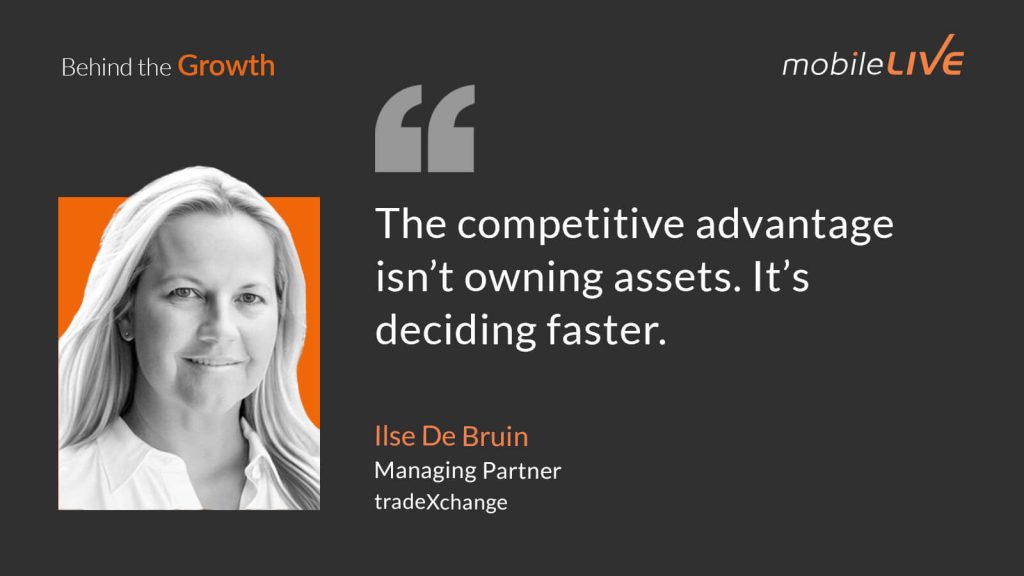
The guest explains a major shift in competitive advantage: moving from asset orchestration to decision orchestration. She highlights that winning organizations are not those that own more infrastructure, but those that can decide faster when disruptions occur. The insight challenges traditional assumptions about scale and control in complex systems.
“The competitive advantage is not really owning the assets, but it’s really deciding faster.”
Customers Are Chasing Clarity
She describes a common but damaging friction in enterprise operations: customers being forced to chase clarity because no one owns the decision or the message. Using a port delay example, she shows how misalignment across operations, finance, and customer service creates confusion and erodes trust. The moment is striking for how familiar and avoidable the problem feels.
“The biggest day to day friction is when customers are forced to chase clarity.”
AI Without Context Is Risky
The guest offers a grounded critique of AI adoption, explaining that AI creates value only when context is already captured and reusable. When critical knowledge lives in emails, chats, or tribal memory, AI can automate actions but not interpret situations reliably. The analogy to a new hire without onboarding makes the risk immediately clear.
“AI can automate, but it can’t really interpret the situation in the most reliable way.”