
Jump To Section
- 1 User Stories and Requirements Serve Different Purposes
- 2 User Story vs. Requirement
- 3 Where Requirements Drift Begins
- 4 Why the Gap Grows at Enterprise Scale
- 5 What a Complete, Testable Requirement Includes
- 6 How Spec-Driven Delivery Closes the Gap
- 7 How SDD Fits with Agile and SAFe
- 8 Questions Leaders Should Ask Before Sprint Entry
- 9 Frequently Asked Questions
- 10 Final Takeaway
Every software delivery program begins with confidence. The backlog is full, sprints are running, and teams are moving. The business sees momentum. Engineering sees productivity. What neither group may see is the growing distance between what the business intended and what the delivery team understood.
That distance often begins when user stories are treated as complete requirements. User stories are useful because they capture intent and help teams organize work. Enterprise delivery needs more. It requires business rules, edge cases, integration logic, security controls, compliance needs, measurable acceptance criteria, and a shared record of the decisions behind them.
When those details remain unwritten, people fill the gaps with assumptions. Each assumption may appear reasonable on its own. Across multiple teams and sprints, the assumptions compound into requirements drift, rework, delayed releases, and outcomes that no longer match the original business need.
This article explains the difference between a user story and a requirement, where the specification gap creates risk, and how Spec-Driven Delivery gives enterprise teams a governed source of truth from business intent through implementation and audit evidence.
User Stories and Requirements Serve Different Purposes
A user story gives a team a concise view of who needs something, what they want to accomplish, and why it matters. For example: “As a customer, I want to view my account balance so I can manage my finances.” That statement provides useful intent and a strong starting point for discussion.
It does not define which accounts are included, how pending transactions appear, when balances refresh, what happens when a data source is unavailable, which accessibility standards apply, how the feature is audited, or how success will be tested. Those details determine what the team builds and whether the result is acceptable.
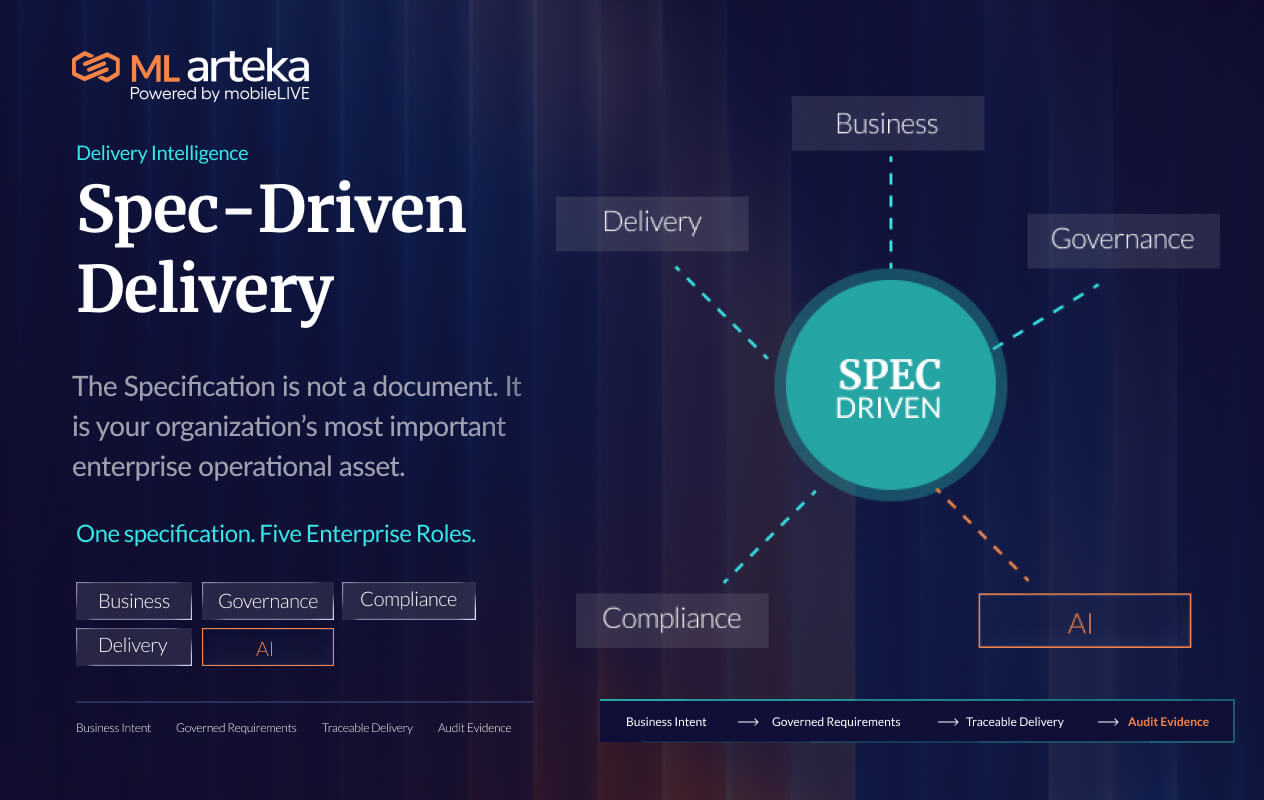
The story starts the conversation. The requirement closes the open decisions needed for delivery. A governed specification brings those requirements together in a form that business, architecture, engineering, quality assurance, security, compliance, and AI-assisted delivery tools can use consistently.
User Story vs. Requirement
| Dimension | User story | Requirement or governed specification |
| Purpose | Communicates user intent | Defines expected behavior and business outcome |
| Detail | Concise and high level | Complete, explicit, and testable |
| Primary use | Backlog planning and prioritization | Delivery, QA, governance, and traceability |
| Core questions | Who, what, and why | Rules, conditions, exceptions, dependencies, and measures of success |
| Validation | Discussed and refined | Reviewed and approved before implementation |
| Lifecycle | May evolve with the backlog | Versioned source of truth throughout delivery |
Where Requirements Drift Begins
Requirements drift begins when different stakeholders fill in the same missing detail in different ways. A product owner assumes one validation rule. An architect assumes a specific data source. A developer chooses a reasonable default. Quality assurance tests against the written ticket. The business evaluates the final experience against an expectation that was never formally captured.
The gap may be small during the first sprint. Later decisions build on it. A date format selected early affects the data model. The data model shapes an integration. The integration changes reporting logic. By the time the issue appears during user acceptance testing, correcting it may require changes across several layers of the solution.
This is why requirements problems become expensive even when every individual team is working competently. The system is producing consistent work from an inconsistent source of truth.
Ambiguity introduced at the start of delivery does not disappear. It becomes the foundation for later decisions.
Why the Gap Grows at Enterprise Scale
A small team working on a low-risk feature may resolve missing details through conversation. Enterprise programs operate under different conditions. Work crosses business units, vendors, platforms, data environments, and regulatory obligations. New stakeholders join after key decisions have been made. Context moves between tickets, documents, meetings, email, and chat.
AI-assisted development raises the stakes further. Code can be generated and changed faster, but speed does not create clarity. When the instruction set is incomplete, AI can scale an assumption as efficiently as it scales a valid requirement. Enterprise teams therefore need a stronger connection between business intent, approved requirements, implementation decisions, testing, controls, and evidence.
The specification becomes the place where that connection is maintained. It gives every participant, human or AI, the same approved definition of what must be delivered and how success will be recognized.
What a Complete, Testable Requirement Includes
A strong requirement set makes the decisions that affect delivery explicit before implementation begins. Depending on the work, it should cover:
- Business outcome and measures: The result the organization is investing in and the metrics that will show whether it was achieved.
- Business rules and decision logic: The conditions, calculations, permissions, thresholds, and policies the solution must apply.
- Data expectations: Required sources, ownership, quality standards, transformations, retention, and lineage.
- Integrations and dependencies: Systems, APIs, events, teams, vendors, and sequence constraints that affect delivery.
- Security, privacy, and compliance: Controls, approvals, evidence requirements, access rules, and regulatory obligations.
- Edge cases and failure states: What should happen when inputs are incomplete, systems are unavailable, or a process cannot continue.
- Acceptance criteria and evidence: The observable conditions that prove the requirement has been satisfied and the records that support that conclusion.
How Spec-Driven Delivery Closes the Gap
ML arteka’s Spec-Driven Delivery (SDD) is an enterprise delivery framework that treats the specification as a governed operational asset. The specification connects business intent, delivery decisions, engineering work, quality assurance, compliance requirements, and AI instructions through one versioned source of truth.
User stories continue to help teams communicate intent and organize the backlog. SDD ensures that a story is supported by complete, validated, and testable requirements before it enters implementation. The result is less interpretation during the sprint and a clearer line from the original business decision to the delivered outcome.
A typical SDD flow follows six connected steps:
- Capture the business outcome, scope, decision rights, and measures of success.
- Develop the governed specification, including rules, dependencies, controls, edge cases, and acceptance criteria.
- Validate the specification with the stakeholders responsible for business, architecture, engineering, QA, security, and compliance.
- Trace implementation work, including AI-assisted output, back to the approved specification.
- Map tests, controls, approvals, and changes to the requirements they validate or modify.
- Produce delivery and audit evidence as the work progresses, rather than reconstructing it after release.
For a deeper explanation of how ML arteka’s Spec-Driven Delivery framework turns specification into a governed operational asset for delivery, compliance, traceability, and enterprise outcomes, read this article
How SDD Fits with Agile and SAFe
Spec-Driven Delivery works alongside existing Agile, Scrum, and SAFe practices. It strengthens the refinement and definition-of-ready stages by making the required level of clarity explicit before sprint entry.
The user story remains the planning unit. The governed specification carries the delivery detail. Teams can still learn, iterate, and respond to change, but changes are versioned, reviewed, and traced instead of being absorbed through informal interpretation.
This shift moves clarification into planning, where it is easier to resolve, rather than leaving the most important decisions for developers and testers to discover during implementation.
Questions Leaders Should Ask Before Sprint Entry
- Can business, engineering, and QA describe the same expected outcome?
- Are business rules, edge cases, dependencies, and integrations explicit?
- Are security, privacy, compliance, and audit requirements included?
- Is success defined through measurable acceptance criteria?
- Can every implementation decision and change be traced to an approved requirement?
- Do AI-assisted tools receive the same governed instruction set as the delivery team?
When the answer to any of these questions is unclear, the delivery risk already exists. The sprint has not removed it. It has only made the eventual correction more expensive.
Frequently Asked Questions
What is the difference between a user story and a requirement?
A user story communicates user intent in a concise format. A requirement defines the rules, conditions, dependencies, controls, and measurable outcomes the solution must satisfy. The story supports planning and conversation. The requirement supports implementation, testing, governance, and traceability.
Can user stories be used as requirements?
User stories can contribute to the requirements process, but they rarely contain enough detail to serve as the complete delivery source of truth for enterprise work. They need supporting specifications that make business rules, edge cases, integrations, controls, and acceptance criteria explicit.
Does Spec-Driven Delivery replace Agile or SAFe?
No. SDD works within existing delivery methods. It strengthens backlog refinement and the definition of ready by ensuring the specification is complete and validated before implementation begins.
Where does SDD fit in a sprint lifecycle?
The core specification work happens before sprint entry, usually during discovery, feature refinement, and backlog refinement. The specification then remains active through implementation, testing, release, and audit evidence collection.
Who owns the specification?
Ownership should be explicit and shared through governance. A product owner or business analyst may coordinate the specification, while business, architecture, engineering, QA, security, and compliance stakeholders validate the parts for which they are accountable.
How does SDD support AI-assisted development?
AI produces more reliable output when it receives clear, structured, and versioned instructions. SDD gives AI-assisted tools an approved specification and creates traceability between what was requested, what was generated, what was reviewed, and what was released.
Final Takeaway
Reliable delivery begins with a shared definition of success. User stories remain valuable because they express intent and help teams organize work. They become risky when the organization expects them to carry business rules, technical decisions, compliance obligations, and testable outcomes that were never written down.
Spec-Driven Delivery gives those decisions a governed home. When the specification remains the source of truth, teams spend less time interpreting, rework is identified earlier, AI-assisted output is easier to govern, and leaders gain a clearer line from technology investment to business outcome.
The practical question is simple: before your last sprint began, could every stakeholder explain exactly what success looked like and point to the same approved source? If the answer is uncertain, the specification gap is the first place to look.
Turn requirements into governed delivery
See how ML arteka’s Spec-Driven Delivery model connects business intent, requirements, engineering, governance, and audit evidence through one traceable specification.